How to Score 90+ in Class 12 Economics Board Exam
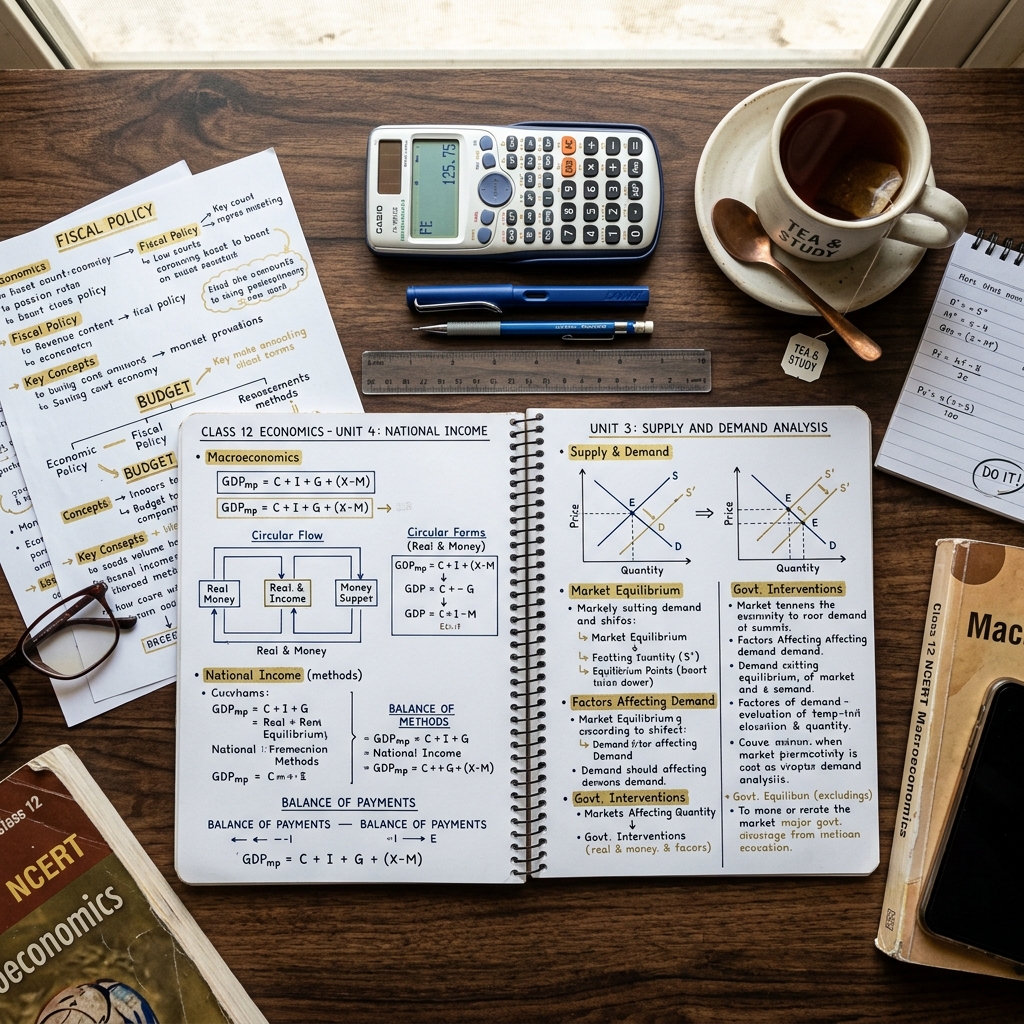
Every year at Pasha Classes in Goalpara, we see the same pattern: students who score 90+ in Class 12 Economics aren't necessarily the "smartest" in the room — they're the ones who study strategically. Here's exactly what that looks like.
1. Understand the Two-Part Structure
Class 12 Economics is typically divided into Macroeconomics (national income, money and banking, government budget, balance of payments) and Indian Economic Development (development experience, current challenges, and Indian economy since 1991). Treat them as two subjects that need separate revision cycles, not one blended blob of "Economics."
2. Master Numericals in Macroeconomics First
National Income calculation and Money & Banking numericals are where marks are won or lost. These questions follow predictable formats:
- National income aggregates (GDP, GNP, NNP, NDP) using expenditure, income, and production methods
- Determination of income and employment (using consumption and investment functions)
- Money multiplier and credit creation problems
Strategy: Solve at least 15–20 numericals per topic from previous years' papers. The formats repeat far more than students expect.
3. Don't Neglect the Theory Sections
Indian Economic Development is heavier on theory and analytical writing — questions on poverty, unemployment, infrastructure, and the impact of globalisation. These need:
- Clear definitions (memorised precisely, not paraphrased loosely)
- Real data points where possible (even approximate, recent figures show the examiner you're aware of context)
- Structured answers with headings/points rather than paragraphs, especially for 4–6 mark questions
4. Use the "3-Pass" Revision Method
- First pass: Read and understand each chapter properly, chapter by chapter.
- Second pass: Make one-page summary notes per chapter — definitions, diagrams, and formulas only.
- Third pass (closer to exams): Revise only your one-page notes, not the full textbook. This is what makes last-minute revision fast instead of panicked.
5. Practice Diagrams Separately
Diagrams — like the aggregate demand-supply curve or the money supply/demand graph — carry dedicated marks for correct labelling. Practice drawing them from memory, not just recognising them when you see them in the book.
6. Time Yourself on Past Papers
Attempt at least 5 full previous years' papers under timed conditions before your final exam. This does two things: it reveals which topics you're slow on, and it trains you to manage the 3-hour paper without running out of time on long-answer questions.
7. Answer Writing Matters as Much as Knowledge
Board examiners award marks based on what's visible on the page. This means:
- Underline key terms
- Use headings for long-answer questions
- Present numerical answers with clear working, not just the final figure
- Don't overwrite — a focused, correct 4-mark answer beats a rambling one
A Realistic Study Plan for the Last 60 Days
| Weeks Before Exam | Focus |
|---|---|
| 8–6 weeks | Complete syllabus + first-pass notes |
| 5–3 weeks | Numerical practice + one-page summaries |
| 2 weeks | Full-length timed papers |
| Final week | Revise summaries + diagrams only |
Learn With Structured Guidance
At Pasha Classes, Ambari, Goalpara, our Class 12 Commerce students follow exactly this kind of structured, exam-oriented approach — regular tests, rapid revision sessions, and backup classes so nothing is missed. If you're preparing for your Economics boards and want a clear path to 90+, explore our Class 12 programme or reach out to us.
Achieve Academic Excellence in Class 12 Boards
Join Pasha Classes in Ambari, Goalpara — Taught by CA Finalist Taznoor Pasha.
Enrol via WhatsApp