Common Mistakes Students Make in Class 12 Accountancy Exams
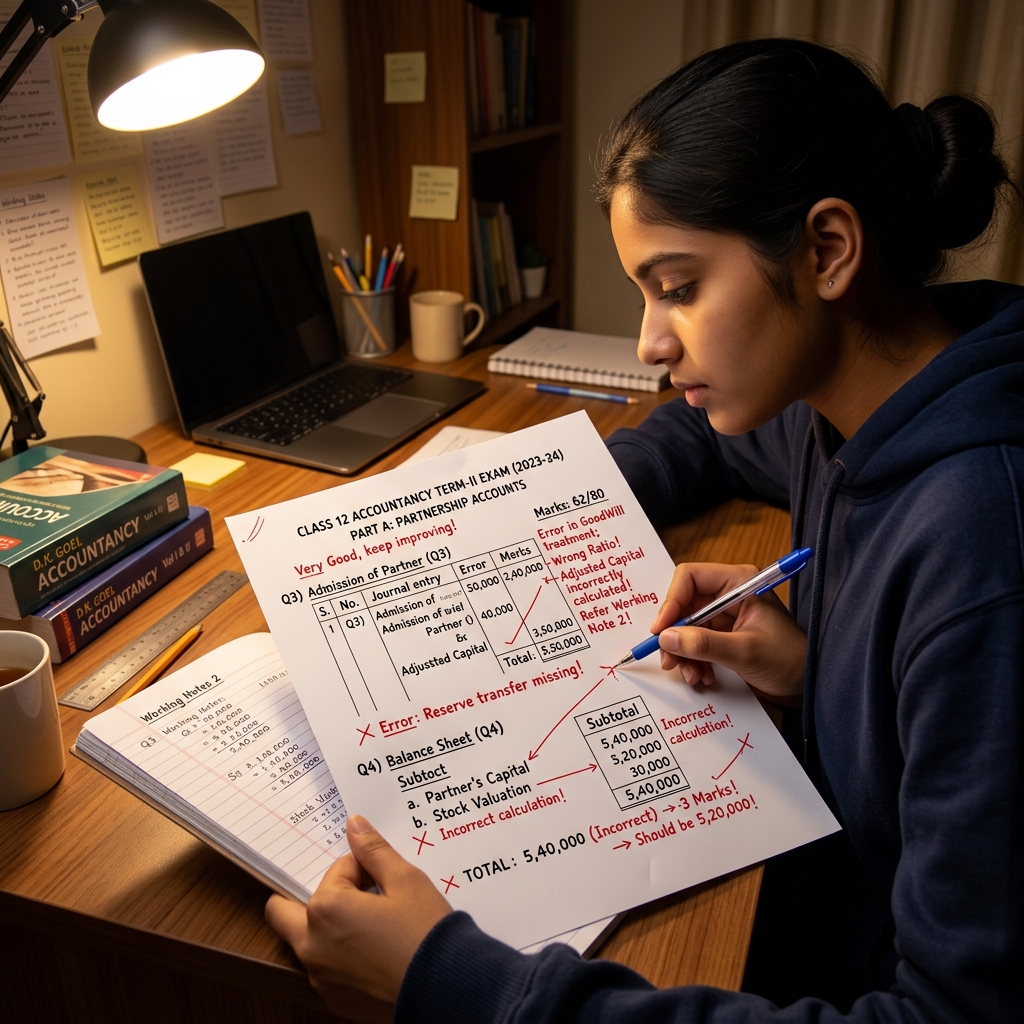
Class 12 Accountancy is one of the more scoring Commerce subjects — the answers are largely objective, formats are learnable, and numericals are practice-based. Yet, year after year at Pasha Classes in Goalpara, we see the same avoidable mistakes cost students real marks. Here's what to watch for.
1. Ignoring the Format of Financial Statements
Partnership final accounts, company accounts, and reconstitution problems all follow specific formats — headings, sub-totals, and the order of items matter. A correct final answer presented in the wrong format often loses presentation marks, even when the calculation itself is right.
💡 Fix: Practice writing out the full format from memory, not just the numbers, until it becomes automatic.
2. Skipping Working Notes
Many students calculate the answer mentally or on rough paper and only write the final figure in the answer sheet. In board exams, working notes are often worth separate marks — and if your final answer is wrong but your working shows correct method, you still earn partial credit. Skipping working notes means losing marks even when your approach was right.
💡 Fix: Make writing working notes a habit from your very first practice paper, not something you add later.
3. Confusing Sacrificing Ratio and Gaining Ratio
In partnership reconstitution (admission, retirement, death of a partner), students frequently mix up:
- Sacrificing Ratio — used when a new partner is admitted
- Gaining Ratio — used when a partner retires or dies
Getting this backwards affects goodwill adjustment entries throughout the entire problem, compounding the error.
💡 Fix: Before starting any reconstitution problem, identify the scenario type first (admission vs retirement/death) and note which ratio applies — before touching the calculation.
4. Treating Goodwill Adjustment as Optional Practice
Goodwill valuation and adjustment questions appear almost every year, in multiple forms (average profit method, super profit method, capitalisation method). Students often practice only one method and get caught off guard when a different method is asked.
💡 Fix: Practice all three valuation methods, even if one is "less common" in your coaching material.
5. Weak Understanding of Share and Debenture Issue Entries
Company accounts — issue of shares at par, premium, or discount; forfeiture and reissue of shares — involve a sequence of journal entries that must be recorded in the right order. A common mistake is jumping straight to forfeiture entries without correctly recording the original application, allotment, and call entries first.
💡 Fix: Treat this as a step-by-step sequence, not a set of standalone entries — always trace through from the beginning of the transaction.
6. Rushing Ratio Analysis and Cash Flow Statements
These newer, more analytical topics (Analysis of Financial Statements, Cash Flow Statement) are sometimes under-practiced because students find Accountancy comfortable with the "core" topics and deprioritise these. But they carry meaningful weightage and are largely formula- and format-based — genuinely easy marks if practiced.
💡 Fix: Don't leave ratio analysis and cash flow statements for the final week. Give them dedicated practice time, since the formats (indirect method, classification into operating/investing/financing) take repetition to internalise.
7. Not Reading the Adjustments Carefully
In final accounts questions, adjustments (outstanding expenses, prepaid income, depreciation, provision for doubtful debts) each affect two places in the financial statements — for example, an adjustment might need to appear in both the Profit & Loss Account and the Balance Sheet. A very common mistake is applying it in only one place.
💡 Fix: After reading each adjustment, explicitly ask: "Where does this appear — Trading A/c, P&L A/c, Balance Sheet, or more than one?"
A Simple Pre-Exam Checklist
- Have I practiced writing full formats from memory, not just calculations?
- Am I including working notes automatically?
- Can I distinguish sacrificing vs gaining ratio instantly?
- Have I practiced all three goodwill valuation methods?
- Have I given dedicated time to Ratio Analysis and Cash Flow Statement?
- Am I double-checking where each adjustment appears?
Learn to Avoid These Mistakes Early
At Pasha Classes, Ambari, Goalpara, our Class 12 Accountancy teaching is built around exactly these recurring problem areas — with regular tests designed to catch these mistakes well before the board exam, not during it. Explore our Class 12 Commerce programme or get in touch with us to learn more.
Master Class 12 Accountancy Without Mistakes
Join Pasha Classes in Ambari, Goalpara — Taught by CA Finalist Taznoor Pasha.
Enrol via WhatsApp