Class 11 vs Class 12 Commerce — What Changes?
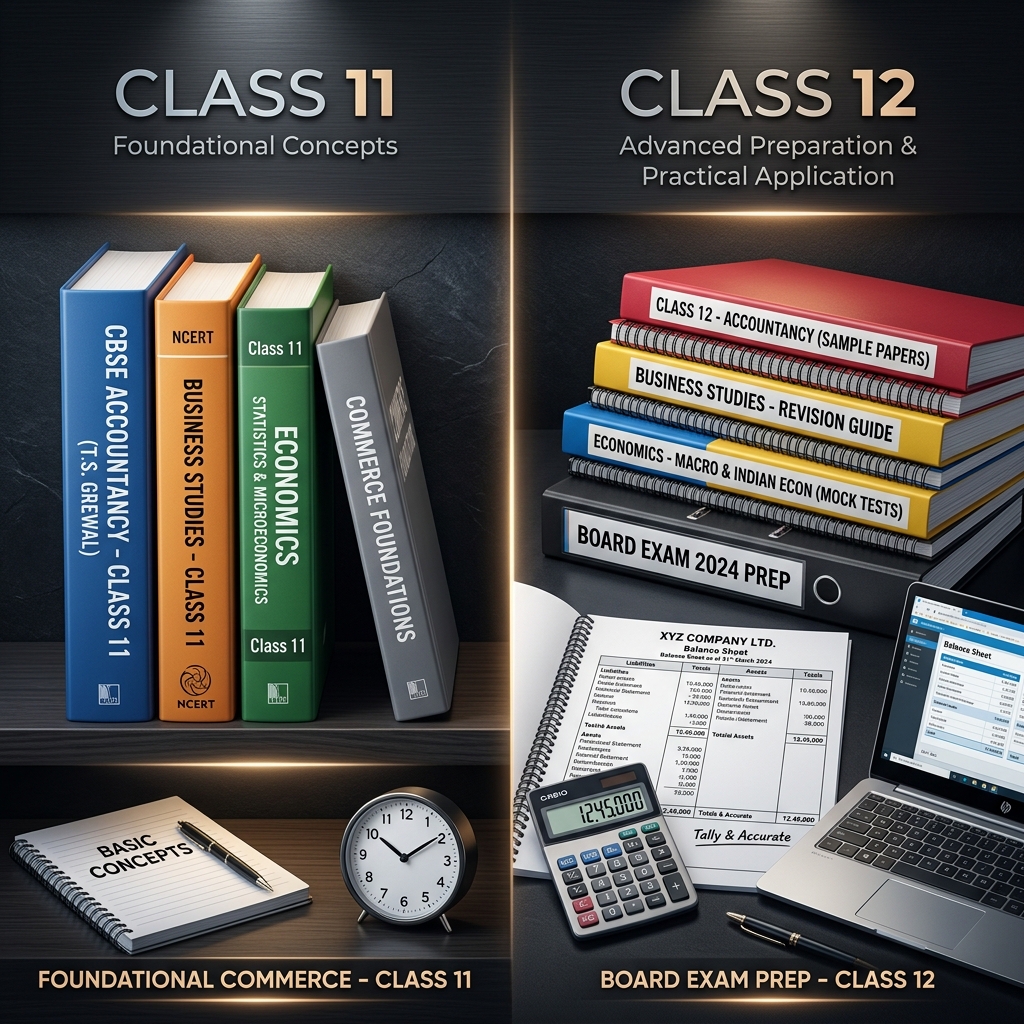
Students often assume Class 12 Commerce is "just a harder version" of Class 11. It's more accurate — and more useful — to think of Class 11 as building the toolkit, and Class 12 as learning to use that toolkit under exam pressure. Here's what actually changes.
1. The Subjects Stay the Same, But the Depth Doesn't
Accountancy, Business Studies, Economics, and (where offered) Finance continue into Class 12 — but each one goes deeper:
- Accountancy: Class 11 teaches you the mechanics — journal entries, ledgers, trial balances, basic financial statements. Class 12 moves into partnership accounting, company accounts (share and debenture issues), and analysis of financial statements, including ratio analysis and cash flow statements. It's a genuine step up in complexity.
- Business Studies: Class 11 focuses on the nature and forms of business, and foundational concepts. Class 12 shifts toward management principles — planning, organising, staffing, directing, controlling — plus business finance and marketing management, which are more analytical and application-based.
- Economics: Class 11 typically covers statistics for economics and introductory microeconomics. Class 12 introduces macroeconomics and the Indian economy, which involve more abstract reasoning and current-affairs awareness.
2. The Stakes Change
Class 11 marks generally matter for internal promotion and building your foundation. Class 12 board exam results matter for college admissions, competitive exam eligibility, and sometimes scholarship applications. This shift in stakes is exactly why Class 12 students often feel more pressure — and why exam technique becomes as important as knowledge.
3. Question Patterns Get More Analytical
Class 11 exams (often school-set) tend to test whether you understood a concept. Class 12 board exams test whether you can apply that concept — case-study based questions, numerical problems combining multiple topics, and long-answer questions that require structured, point-wise reasoning rather than simple recall.
4. Continuous Assessment Becomes More Important
In Class 12, most schools and coaching institutes shift toward regular test series and mock board exams, because familiarity with the exam format directly impacts performance. Backup classes and revision sessions matter more here — falling behind in Class 12 is costlier to recover from than in Class 11.
5. What Should Change in How You Study
| Aspect | Class 11 Approach | Class 12 Approach |
|---|---|---|
| Goal | Build conceptual foundation | Apply concepts under exam conditions |
| Study style | Understand + basic practice | Practice past papers + timed tests |
| Revision | End of term | Continuous, cycle-based |
| Focus subjects | Equal weight to all | Identify and shore up weak areas early |
The Most Common Mistake
Students who scored well in Class 11 sometimes assume Class 12 will be "more of the same" and under-prepare in the first few months. Because Class 12 syllabus is denser and board exams are unforgiving of last-minute cramming, starting strong from Day 1 of Class 12 — not just before boards — makes a significant difference.
A Smooth Transition, Guided
At Pasha Classes, Ambari, Goalpara, we structure our Class 11 teaching to directly prepare students for the jump into Class 12 — so the transition feels like a natural next step, not a shock. If you're moving from Class 11 to Class 12 Commerce and want continuity in how you learn, explore our courses or get in touch.
Prepare for Your Class 12 Boards with Pasha Classes
Join Pasha Classes in Ambari, Goalpara — Taught by CA Finalist Taznoor Pasha.
Enrol via WhatsApp