Class 11 Accountancy Syllabus 2026-27 — Full Breakdown
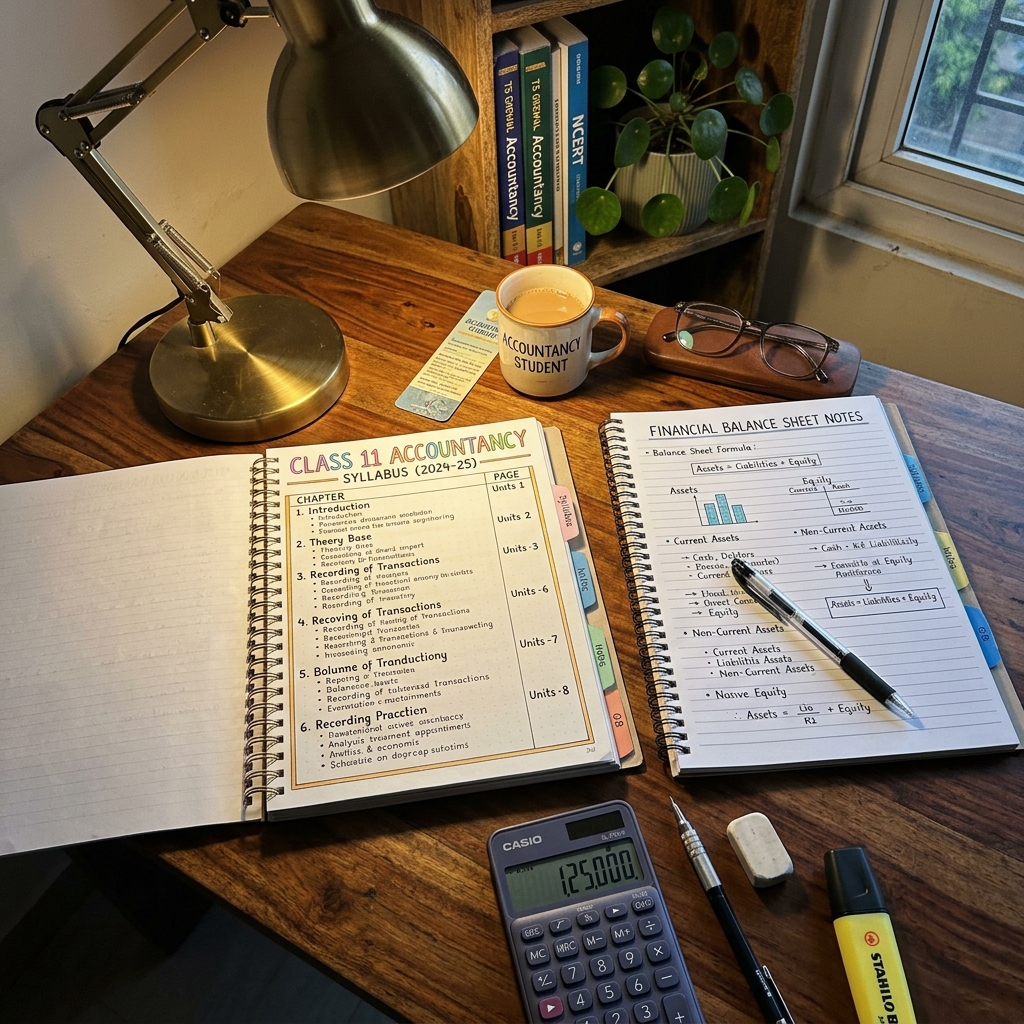
Starting Class 11 Accountancy can feel overwhelming if you don't know what's coming. At Pasha Classes in Goalpara, this is one of the first questions new students ask us: "What exactly do I need to study, and in what order?" Here's a clear, no-fluff breakdown of the syllabus so you can walk into the year with a plan instead of anxiety.
Unit 1: Theory Base of Accounting
This is the foundation everything else is built on. You'll learn what accounting actually is, why it exists, and the rules that govern it — things like accounting concepts, principles, and conventions. It also introduces the difference between cash basis and accrual basis of accounting, and touches on Accounting Standards and Ind-AS at a basic level.
Why it matters: Students who rush through this unit almost always struggle later, because every subsequent topic assumes you understand these basic rules.
Unit 2: Accounting Process
This is the practical heart of Class 11 Accountancy, and it's where most of your exam marks come from. It covers:
- Journal entries — recording transactions correctly
- Ledger posting — organizing entries by account
- Trial balance — checking that your books balance
- Subsidiary books — cash book, purchases book, sales book, and returns books
- Bank Reconciliation Statement — matching your cash book with the bank passbook
- Depreciation, Provisions and Reserves — accounting for asset wear-and-tear and future liabilities
- Bills of Exchange — a topic many students find tricky, involving promissory notes and bill discounting
- Rectification of Errors — finding and correcting mistakes in the books
If there's one section to master before moving forward, it's this one. Everything in Class 12 assumes you're fluent in journal entries and ledgers.
Unit 3: Financial Statements of Sole Proprietorship
Here you learn to prepare the Trading and Profit & Loss Account and the Balance Sheet for a sole proprietor business, including adjustments for closing stock, outstanding expenses, prepaid expenses, and accrued income. This unit is where accounting starts to feel like a real business skill rather than just bookkeeping.
Unit 4: Financial Statements of Not-for-Profit Organisations
This unit shifts focus to clubs, societies, and charitable institutions. You'll prepare a Receipts and Payments Account, an Income and Expenditure Account, and a Balance Sheet for organisations that don't operate for profit. It looks different from business accounting at first, but the underlying logic is the same.
Unit 5: Computers in Accounting
A shorter, more conceptual unit covering computerised accounting systems, the advantages and limitations of computerised accounting compared to manual accounting, and a basic introduction to accounting software. Some boards also test data processing cycles here.
How to Approach the Year
- Don't skip Unit 1 even though it feels theoretical — it's short but foundational.
- Practice Unit 2 daily. Journal entries and ledgers need repetition, not just understanding.
- Treat Units 3 and 4 as applications of Unit 2 — if you're solid on journal entries, financial statements become much easier.
- Revisit Bills of Exchange and BRS separately closer to exams, since students often forget the specific formats.
A Note on Board-Specific Variations
While the core structure above follows the widely-used NCERT-based Commerce curriculum, always cross-check the exact unit weightage and any state-specific additions with your current board's official syllabus for the year, since minor changes are made from time to time.
Get Guided Support
At Pasha Classes, Ambari, Goalpara, we teach this exact syllabus with real-life examples and regular practice tests so concepts stick — not just for the exam, but for good. If you're a Class 11 student in Goalpara looking for structured Accountancy coaching, get in touch with us or explore our courses.
Master Class 11 Accountancy with Confidence
Join Pasha Classes in Ambari, Goalpara — Taught by CA Finalist Taznoor Pasha.
Enrol via WhatsApp